

How the ConBotics Painter Robot and Flexi Net Create Safer, More Predictable Jobsite Workflows
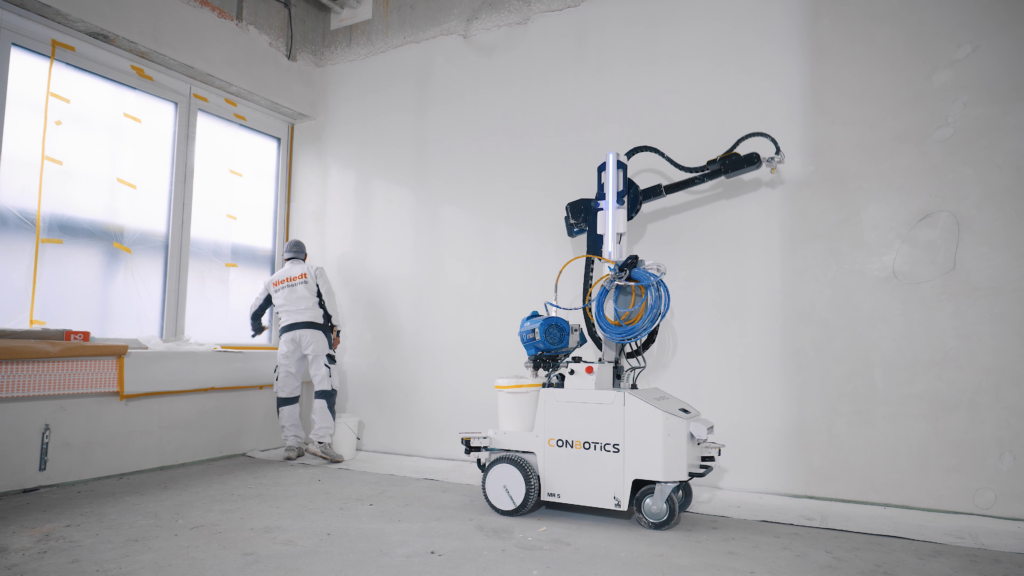
Across the skilled trades, contractors are juggling full project pipelines with teams that are stretched thin. That’s why automation is becoming less of a “nice‑to‑have” and more of a practical solution for handling repetitive, physically demanding tasks. ConBotics is stepping directly into this gap with an autonomous, mobile painting robot built to take over large‑scale airless spraying – accurately, consistently, and with the reliability construction crews depend on.
Led by CEO and co‑founder Cristian Amaya Gómez, the ConBotics team is designing a system that makes one of the most time-consuming jobsite tasks predictable, repeatable, and easier to schedule. But from day one, the company knew that perfect spray quality alone wasn’t enough. The real test was whether the robot could perform safely and dependably on a live jobsite, where people move unpredictably and obstacles appear without warning.
Safety as a foundation, not a feature
Drawing on robotics experience gained at Fraunhofer IPK, the ConBotics founders quickly built a functional prototype capable of stable motion control and repeatable path planning. However, as the team shifted closer to on‑site validation, it became clear why many autonomous systems struggle to make it out of the lab: achieving product‑ready reliability and safety is far more complex than getting a robot to work in controlled environments.
A true jobsite‑ready robot must react predictably when someone steps into its workspace or when unexpected objects block its route, without compromising coating quality or user confidence. Amaya and his team recognized early that safety couldn’t be added on later. It needed to shape the architecture from the beginning.
With a small development team, ConBotics chose not to build a safety framework from scratch. Instead, they focused their engineering resources on what differentiates the product—robotics, automation, and painting expertise—while seeking a ready‑made safety platform that was reliable, cost‑effective, and fast to integrate.
A practical safety architecture powered by Flexi Net
ConBotics found that platform in the SICK Flexi Net safety controller. Flexi Net taps into existing drive data, reads CANopen data from the chassis, and pairs it with economical HTL encoders. Through certified motion function blocks, this data is transformed into safe positional and speed values.
Because Flexi Net will work hand‑in‑hand with the robot’s current drive components, it significantly cuts down on extra hardware, wiring, and integration steps—resulting in a streamlined safety setup that doesn’t compromise motion quality or system performance.
Built‑in scalability with EFI‑pro
Once the core safety structure was in place, ConBotics could expand its system quickly without starting from scratch each time. SICK’s broad sensor lineup can be integrated cleanly through EFI‑pro, the company’s unified communication network for safety devices.
For the ConBotics Painter Robot, this cohesive setup simplified commissioning, reduced one‑off interfaces, and shortened diagnostics time. Examples include:
- DFS60B incremental encoder for precise, repeatable path movement
- WTT12‑S optical sensing to detect edges, stair openings, and potential drop‑offs
- IQB2S mechanical monitoring to ensure components like the spray gun are correctly locked
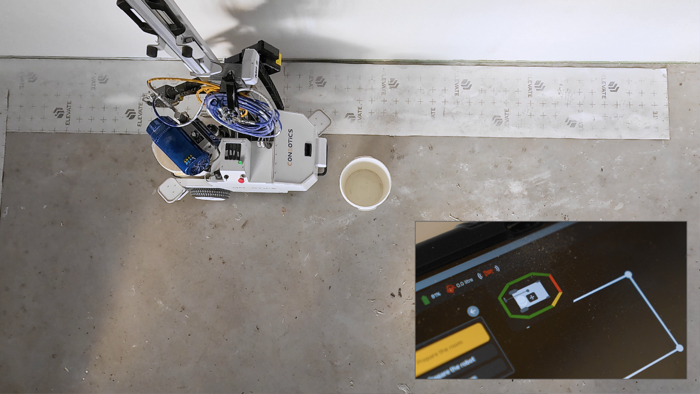
- nanoScan3 safety laser scanners to identify people or objects—such as ladders, buckets, or materials—in the robot’s path
Certification‑ready from the start
As the robot matured toward real‑world deployment, certification became a critical consideration. Using SICK’s pre‑certified safety components and validated function blocks allowed ConBotics to significantly reduce both risk and time spent on verification.
Instead of documenting every individual safety function from scratch, the team could focus on tailoring the integration to their application. This clarity translated into a smoother path from prototypes to pre‑production units—often a make‑or‑break stage for robotics startups.
Integration backed by real technical support
For ConBotics, the advantage wasn’t just SICK’s hardware—it was the hands‑on engineering support. SICK provided test kits, application guidance, and help all the way through commissioning, reducing trial‑and‑error cycles and speeding up validation on real jobsites.
Amaya highlights the combination as key: a robust catalog of proven safety components, a unified EFI‑pro integration approach, and technical partnership that empowered the ConBotics team without taking ownership away.
A safer, smarter future for painting automation
Through this partnership, ConBotics can stay focused on delivering what contractors truly need: a reliable, autonomous painting system that eases labor pressures and boosts efficiency on the jobsite.
With Flexi Net as its safety backbone and a scalable ecosystem of SICK components, the ConBotics Painter Robot is already proving itself in real working environments—and helping companies operate more predictably even with limited personnel.